

Donald Trump's antics stoke new opposition
For organizations that encourage and train women to run for political office, this has been a very busy four months since Election Day.
President Donald Trump’s continuing assaults on cherished American ideals, like protecting the environment and providing health care, are having an intriguing side effect. His administration is keeping the outrage at a boil.
For organizations that encourage and train women to run for political office, that has made for a very busy four months since Election Day.
Women, especially, are expressing interest in running for public office.
Activism has spiked in many areas, from demonstrations in airports to raucous town halls to protests at politicians’ doorsteps. But the events of the last few months have fundamentally changed attitudes about politics, particularly among women. Organizers say many more women are embracing the value of running for office.
VoteRunLead, a nonpartisan nonprofit organization that offers classes with titles like “30 Things Every Woman Needs to Know to Run for Office,” recently surveyed women who had signed up for the program. In the past, two-thirds of VoteRunLead’s students said they were thinking of running in the next five years or so. When their children were grown, perhaps.
Now, according to VoteRunLead founder Erin Vilardi, 66 percent want to run in the next two years.
“In the past, we heard, it’s on my mind, but it’s not urgent,” she said. “A new crop of women are raising their hands and accelerating the schedule.”
VoteRunLead, which is based in New York, unveiled a website this week under the banner “Run as you are.” An important function of groups like this is matching the skills and passions of individuals with the right offices.
“Probably, the number one question I get is what to run for,” Vilardi says. She begins by asking what policies they want to change. Most will end up seeking school board or local offices, with a sprinkling interested in federal posts.
From September 2014 to the November election, VoteRunLead trained about 5,000 women at conferences and online. Since Nov. 8, another 5,565 have signed up. Organizations like the Center for American Women and Politics at Rutgers University, She Should Run and Ignite National are reporting similar surging interest.
Even optimists thought interest might fade after the Jan. 21 women’s marches. But Anne Moses, president of Ignite National, which offers programs for high school and college women, says so far, apathy has been a stranger. “I thought maybe it would slow down,” she said, “but this administration is doing a good job of keeping people angry.”
Cue Hillary Clinton. On Tuesday, she gave a major speech in San Francisco to an audience of 6,000, and she’s scheduled today to address the Georgetown Institute for Women, Peace and Security in Washington. On Tuesday, she tried out a new mantra: “Resist, insist, persist, enlist.”
Her timing was perfect. Last week brought the image of a room of men in Congress debating whether to cover maternity care, along with Kansas Sen. Pat Roberts making light of losing mammograms. He was forced to apologize.
Such moments are raising awareness in young women that “sexism is real, it’s not just something my mom is talking about,” said Moses of Ignite National, which is based in San Francisco.
The recent ineptitude of the White House — failing on two travel bans and Obamacare repeal — also demonstrates, like a reality show, that no experience is necessary to try governing. The missteps have been liberating for potential candidates, and especially women, who research shows tend to underestimate how well-prepared they already are for jobs.
Who knew that Trump’s Washington would offer so much inspiration?
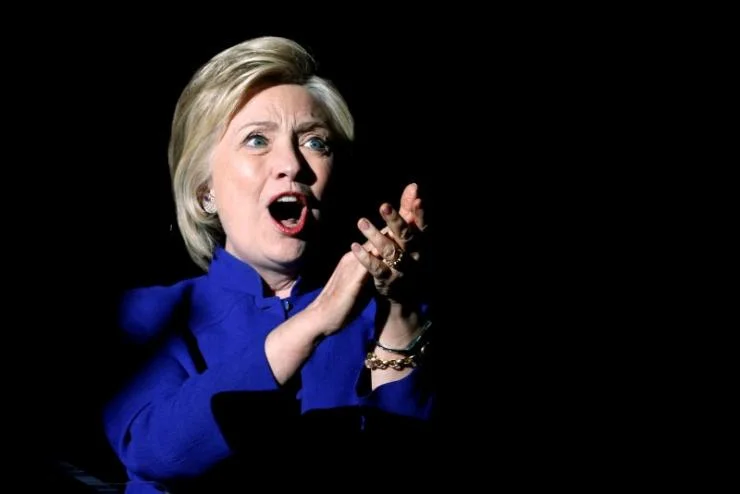
Hillary's path to power required Faustian bargain
From mapping a path to power to laudable notions of holding the family together, "Why They Stay" examine the uniquely challenging Faustian bargains that political wives grapple with.
Hillary Clinton couldn’t have known in 1998 how her husband’s high-profile philandering would play out. Would he be rehabilitated in the public eye? She couldn’t be sure, but she took the gamble. Had she left the marriage, today she might be the spurned wife of a retired politician instead of on the precipice to lead the free world.
Looking back on the path chosen by the nine political wives profiled in "Why They Stay: Sex Scandals, Deals, and Hidden Agendas of Nine Political Wives," we have the evidence to see a pattern—as old as the dynastic maneuverings of England’s medieval queens. The women married to the “royalty” of our times—politicians—make similar cold calculations in order to hold onto their “thrones” and their family’s history-making potential.
After covering politicians for decades as a reporter and columnist, I switched my gaze to the women behind the cheating men. Drawing from multiple sources that span the Roosevelts’ marriage to the more recent scandal involving Hillary Clinton’s closest aide Huma Abedin (wife of “sexter,” Anthony Weiner), "Why They Stay" argues that when it comes to the “power behind the throne,” women in the limelight weigh the risks and rewards. They remain loyal to their men, because of complex, often unconscious forces.
From mapping a path to power to laudable notions of holding the family together, I examine the uniquely challenging Faustian bargains that political wives grapple with, even as the public spotlight illuminates their every move.
Publishing in March 2017, Why They Stay explores the possible reasoning and motivation behind why political wives stay with their husbands after the husbands cheat. For updates on the book launch, sign up at whytheystaybook.com.